The Art Hidden in Quantum Noise: Why Decoherence Is the Medium
Every quantum computer is in a war with the universe.
The moment you prepare a qubit in superposition — balanced on that knife-edge between 0 and 1 — the environment begins to intrude. Stray photons, thermal vibrations, electromagnetic whispers from a cable three meters away. The qubit starts to forget what it was supposed to be. Physicists call this decoherence.
Two timescales define the decay. T1 is the energy relaxation time — how long before an excited qubit falls back to its ground state, like a ball rolling downhill. T2 is the dephasing time — how long before the qubit's phase information dissolves into noise. On IBM's superconducting processors, both are measured in microseconds. Your circuit has a few hundred nanoseconds to run before the universe reclaims its randomness.
I spent a lot of time fighting this noise while building the Quantum Genesis collection. At first I treated it like a bug. Then I realized it was the entire point. This post is about why I came around — and why the flaws in quantum measurements turned out to be the most honest source of randomness I've ever worked with.
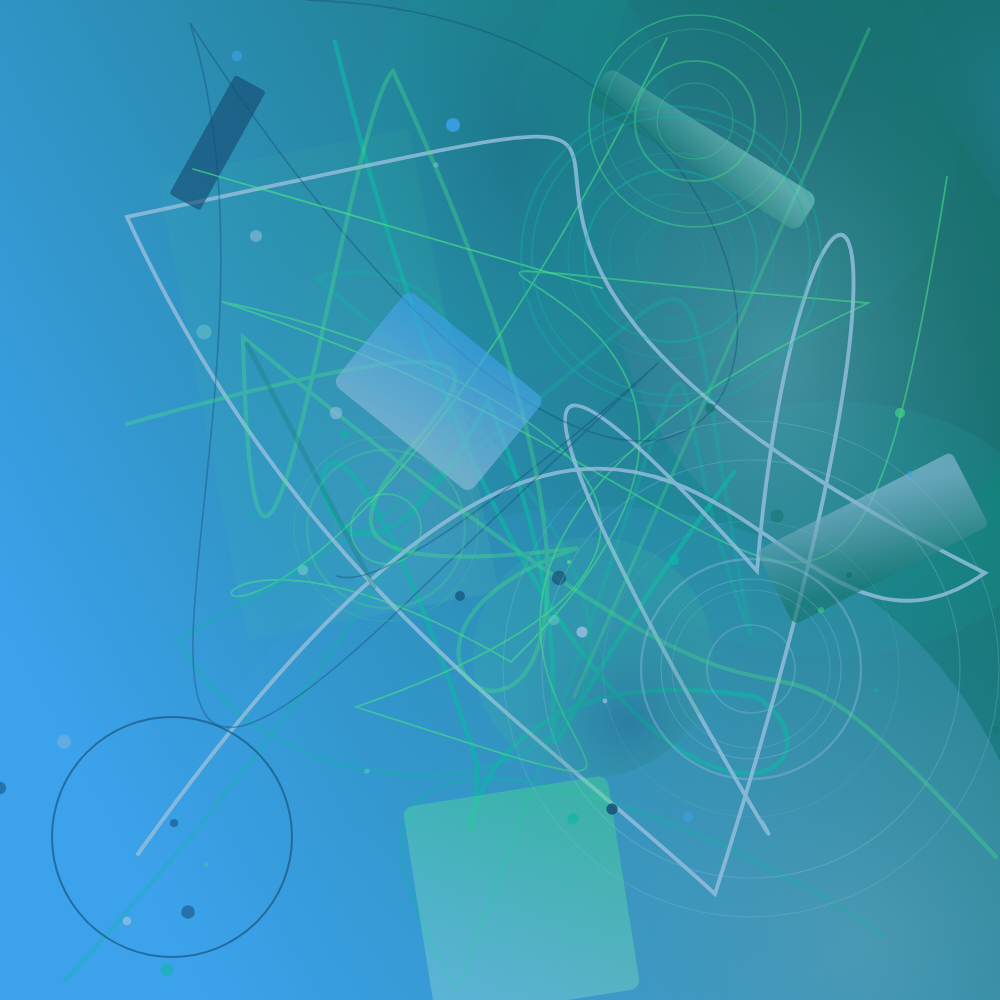
The beauty of imperfection
Classical computers can simulate randomness but cannot produce it. Every pseudorandom generator is a deterministic function wearing a mask. Give it the same seed and it produces the same sequence, forever. The randomness is an illusion — a convincing one, but an illusion.
Quantum noise is different. It is genuinely, provably, irreducibly unpredictable. Not because we lack information about the system. Not because the computation is too complex to follow. But because the universe itself has not decided the outcome until the moment of measurement.
That distinction matters for art. When a generative artist reaches for Perlin or simplex noise, they are sculpting with deterministic chaos — beautiful, but repeatable. When we use quantum noise, we are sculpting with something that has never existed before and can never be reproduced. Each measurement is a one-time event in the history of the universe. The imperfections in our measurements are not flaws to be corrected. They are the signature of reality itself.
How noise shows up in the measurements
We run a 12-qubit Hadamard + CNOT circuit on real hardware. The ideal output is a perfectly uniform distribution across all possible bitstrings. That never happens. Here's what the noise actually does.
Bit-flip errors. A qubit that should read 0 occasionally reads 1, and vice versa. These are not uniform — they depend on each individual qubit's physical characteristics. Qubit 7 on ibm_fez might show a 0.3% error rate while qubit 42 shows 1.2%. Those asymmetries ripple through the statistics, creating subtle biases that shift from processor to processor and day to day.
Decoherence shifts. As the circuit executes, qubits lose coherence at different rates. By measurement time, the probability distribution has drifted from the ideal. Entangled pairs partially disentangle. Superpositions partially collapse. The result is a probability landscape that is neither perfectly uniform nor completely random — something more interesting than either.
Processor fingerprints. Every quantum processor has a unique noise profile. Crosstalk between neighbors, calibration drift over hours, the specific T1/T2 of each qubit — these form a fingerprint as distinct as a human voice. Two identical circuits on two different processors produce statistically distinguishable output distributions.
This is a feature, not a problem. Each processor leaves its mark on the art it helps create.
Real versus fake randomness
Most generative art runs on pseudorandomness: Perlin, simplex, Mersenne Twister, xorshift. Beautiful results, but deterministic — every output is predetermined by its seed.
Quantum Genesis uses a fundamentally different source:
def build_nft_seed_circuit(num_qubits=12):
    qc = QuantumCircuit(num_qubits, num_qubits)
    # Hadamard layer: maximum superposition
    for i in range(num_qubits):
        qc.h(i)
    # CNOT chain: maximum entanglement
    for i in range(num_qubits - 1):
        qc.cx(i, i + 1)
    qc.measure_all()
    return qc
This creates a maximally entangled state across 12 qubits. Measured with 4,096 shots, it produces a distribution of bitstrings encoding the processor's physical state at that exact moment. We hash those measurements with SHA-512 to produce a seed, then feed it into the art generator.
The result is art seeded by the actual quantum state of matter. Not a simulation, not an approximation — the real thing. Classical generative art is a recording; quantum generative art is a live performance that can never be replayed.
Origin Quantum vs IBM Quantum: two voices
The collection was generated on two different platforms, and the difference is audible if you know how to listen.
NFTs #1–18: Origin Quantum WK_C180. A 180-qubit superconducting processor built in Hefei, China. Its noise characteristics are distinct from IBM's — different fabrication process, different coupling topology, different error profiles. The first 18 pieces carry Origin's unique quantum voice, with color distributions and entropy profiles reflecting WK_C180's specific decoherence. They're the origin of our origin story.
NFTs #19–100: IBM Quantum (ibm_fez and ibm_torino). The remaining 82 pieces came from IBM's ibm_fez (156 qubits) and ibm_torino (133 qubits). Their Eagle and Heron processors use a heavy-hex topology with different crosstalk patterns and gate fidelities. The seeds carry a detectably different statistical signature.
Set an Origin piece next to an IBM piece and both are abstract, both are beautiful — but they speak different quantum dialects. The noise is different, the entropy distributions are different, the art is different.
Quantum Genesis #1 — born from Origin's WK_C180; the texture and color distribution reflect that chip's unique decoherence profile.
Quantum Genesis #19 — the first IBM piece. Notice the shift in texture density and color harmony compared with the Origin pieces.
Our noise texture layer
Each piece has a dedicated noise texture layer — hundreds of tiny semi-transparent dots scattered across the canvas by the quantum RNG. It produces a grain reminiscent of analog film photography or risograph printing.
The dots aren't on a grid, and they aren't jittered with Gaussian noise. Each dot's position, size, and opacity come from a sequence of values drawn from our QuantumRNG class:
class QuantumRNG:
    """Seeded from SHA-512 of quantum measurement hex seed.
       Uses xorshift128+ style generation."""

    def __init__(self, hex_seed):
        digest = hashlib.sha512(hex_seed.encode()).hexdigest()
        self.state = [int(digest[i:i+16], 16) for i in range(0, 64, 16)]

    def next_float(self):
        # xorshift128+ algorithm
        s1 = self.state[0]
        s0 = self.state[1]
        self.state[0] = s0
        s1 ^= (s1 << 23) & 0xFFFFFFFFFFFFFFFF
        self.state[1] = s1 ^ s0 ^ (s1 >> 17) ^ (s0 >> 26)
        return ((self.state[1] + s0) & 0xFFFFFFFFFFFFFFFF) / (1 << 64)
The seed comes straight from quantum hardware, so every downstream random value inherits that quantum origin. The noise texture layer is, in a literal sense, a visualization of quantum decoherence.
Beyond the noise texture, each piece also has a particle layer — larger geometric shapes (circles, arcs, lines) whose positions, sizes, and rotations are all quantum-determined. The particles provide compositional structure while the noise texture adds depth and materiality. Together they produce art that feels organic and physical despite being entirely digital.
The philosophical angle
Here's the thing about quantum measurement most people miss: it is not observation in the ordinary sense. When you measure a qubit, you are not discovering a pre-existing value. You are forcing the universe to make a choice that did not exist until that moment.
This is not metaphor. It is the experimentally verified, mathematically precise description of quantum measurement. Bell's theorem, confirmed in countless experiments, proves the outcomes cannot have been predetermined. The universe genuinely decides at the moment of measurement.
Each of our 100 pieces is a frozen record of 4,096 such decisions. Twelve qubits times 4,096 shots is 49,152 individual qubits forced to choose — and their collective choice became the seed for a unique artwork. Each NFT is not a picture of randomness. It is a fossil of quantum decisions.
Each piece carries a Quantum Phase attribute based on its entropy characteristics:
- Superposition — pure potential, before the universe decides. High entropy, balanced distributions.
- Interfering — quantum waves overlapping into patterns of reinforcement and cancellation. Medium-high entropy with visible structure.
- Entangled — qubits bound together, their fates correlated across space. Distinctive correlation patterns in the measurement data.
- Collapsed — the moment of decision. Lower entropy, stronger biases — the noise has spoken most forcefully here.
These are not arbitrary labels. They reflect genuine statistical properties of the data that seeded each piece. A "Collapsed" piece looks and feels different from a "Superposition" piece because the underlying quantum data is structurally different.
The highest-entropy pieces
The highest-entropy pieces are, mathematically, the most "quantum" — their seeds came from measurements closest to the ideal of perfect randomness.
Quantum Genesis #7 — an Origin Quantum piece with near-maximum entropy. The complementary harmony and fine grain create an almost cosmic quality, as if peering into the quantum vacuum.
Quantum Genesis #73 — an IBM piece in the "Entangled" phase. The split-complementary palette and layered particles create a depth that pulls you inward, like falling into a quantum potential well.
Decoherence is the medium
I did not set out to make art about quantum physics. I set out to make art with quantum physics, and the distinction matters. The quantum noise is not a theme or a metaphor in the work. It is the material itself — the paint, the canvas, and the brush all at once.
Every imperfection in the measurements made the art more interesting, more varied, more alive. The decoherence that quantum engineers spend fortunes trying to eliminate is exactly what makes each of the 100 pieces unique. The noise is not the enemy. The noise is the art.
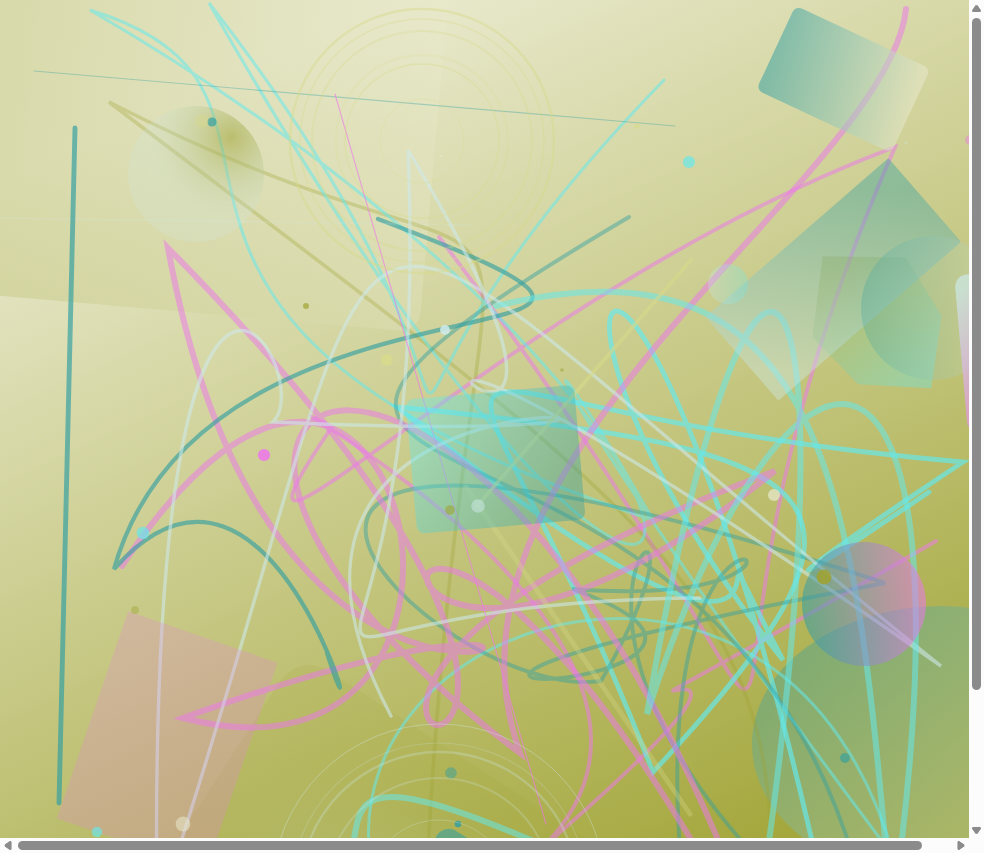
The collection described here is on-chain: Quantum Genesis (100 pieces, Polygon).


Comments
Post a Comment