Why quantum randomness is the interesting part of generative art
There's a gap between how generative art feels and how it actually works, and it took us a while to get honest about it. Every generative project leans on "randomness" for its uniqueness — but under the hood, most of them are running a deterministic PRNG. Same internal state, same output, always. The stronger claim we wanted to make for Quantum Genesis wasn't about aesthetics; it was about the seed itself coming from a quantum measurement, which is a different kind of event than a PRNG step.
This post is about that difference in concrete terms, because "quantum randomness" gets thrown around a lot and rarely pinned down. It covers why classical generative art is pseudorandom, what a real measurement changes, and the math behind why two seeds essentially can't collide. No real investment thesis here — we're an experiment and a study case, not an opportunity.
The catch under every Math.random()
Every generative art project you've seen — Art Blocks, fxhash, Tyler Hobbs' Fidenza — shares a fundamental limitation: pseudorandomness.
When an artist writes Math.random() or uses a seeded PRNG, they're using a deterministic algorithm. Given the same internal state, you get the same output, always. The "randomness" is an illusion — a sufficiently motivated actor with enough compute could reverse-engineer the seed, reproduce the piece, or predict future outputs.
For somebody choosing a piece as a lasting record, this matters, because provenance requires irreproducibility. If the generative process can be replicated, the uniqueness rests on social agreement rather than anything in the math.
What a real measurement changes
Quantum Genesis operates on a different physics entirely. When you put a qubit in superposition via a Hadamard gate and measure it, the outcome (0 or 1) is governed by the Born rule of quantum mechanics. No hidden variable determines it, no algorithm produces it — it simply happens, a fundamentally unpredictable event at the physical level.
Our pipeline:
- 12-qubit circuit on real hardware (IBM Quantum ibm_fez / Origin Quantum WK_C180).
- 4,096–8,000 shots per NFT — each shot a quantum measurement.
- Measurement distribution → SHA-256 → 256-bit quantum seed.
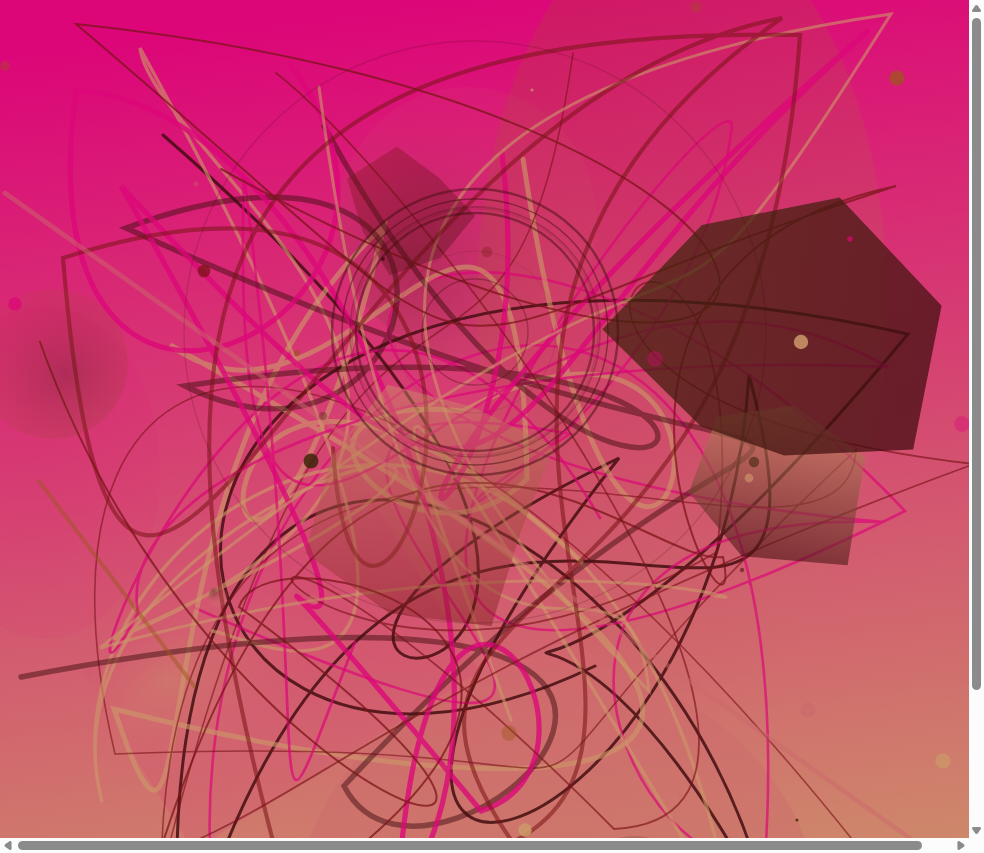
- Deterministic RNG drives every visual decision from that seed.
The art is deterministic from the seed. But the seed came from quantum physics, and it physically cannot be reproduced — not by us, not by anyone, not with infinite compute. The measurement event existed for a microsecond and then collapsed. The information is gone from the universe except for what we recorded.
Why two seeds can't coincide
Each NFT's seed is a 256-bit hex string (64 characters). The seed space: 2²⁵⁶ ≈ 1.15 × 10⁷⁷ possibilities. For perspective: there are roughly 10⁸⁰ atoms in the observable universe — the seed space is a meaningful fraction of that scale.
But the argument is stronger than the size of the space. Classical generative art takes seeds from a PRNG with a much smaller, predictable state space. Our seeds come from the full probability distribution of a 12-qubit system measured thousands of times. The min-entropy of our seeds is provably higher than any classical source, and the collision probability is effectively zero — not "astronomically low," but physically impossible within the lifetime of the universe.
Provenance that can be run, not believed
Every Quantum Genesis NFT carries immutable on-chain and on-IPFS metadata:
- Quantum seed — the SHA-256 hex, verifiable by anyone running our open-source generator.
- Processor identity — IBM ibm_fez, ibm_torino, or Origin WK_C180.
- Timestamp — exact measurement microsecond (ISO 8601).
- Shots count — 4,096 (IBM) or 8,000 (Origin).
- Circuit specification — 12 qubits, H + CNOT topology.
- Entropy metrics — level, score (0–100), configuration type.
Verification is trivial: take the seed from the metadata, run the generator, get the exact same SVG. The seed's origin is a quantum measurement at a specific time on a specific processor. Whether that history is worth recording is a question about provenance, not about price — and it's the question I'm genuinely curious to hear others reason through.


Comments
Post a Comment